
How to Keep Aging Parents Safe at Home When You Can't Be There
How to Keep Aging Parents Safe at Home When You Can't Be There
There is a stage almost every family goes through, and almost nobody talks about it.
Your dad is still living at home. He still drives to the deli on Tuesdays. He would tell you, firmly, that he is fine. But you have started noticing things. He repeated the same story twice on Sunday's call. There was a bruise on his arm he could not quite explain. The pill organizer you set up for him looked untouched when you visited. You are not ready to bring a caregiver into his house, and honestly, he is not ready to let one in. But doing nothing feels wrong too.
After 16 years in home care, we can tell you this in-between stage is one of the hardest places for a family to be. Full-time care is not the right answer yet. Waiting for a crisis is not an answer at all. For years, families in this stage had only bad options: push a parent into care he does not want, or hold your breath and hope the phone does not ring at 2 a.m.
Now there is a third option: start with data.
What "Starting With Data" Actually Means
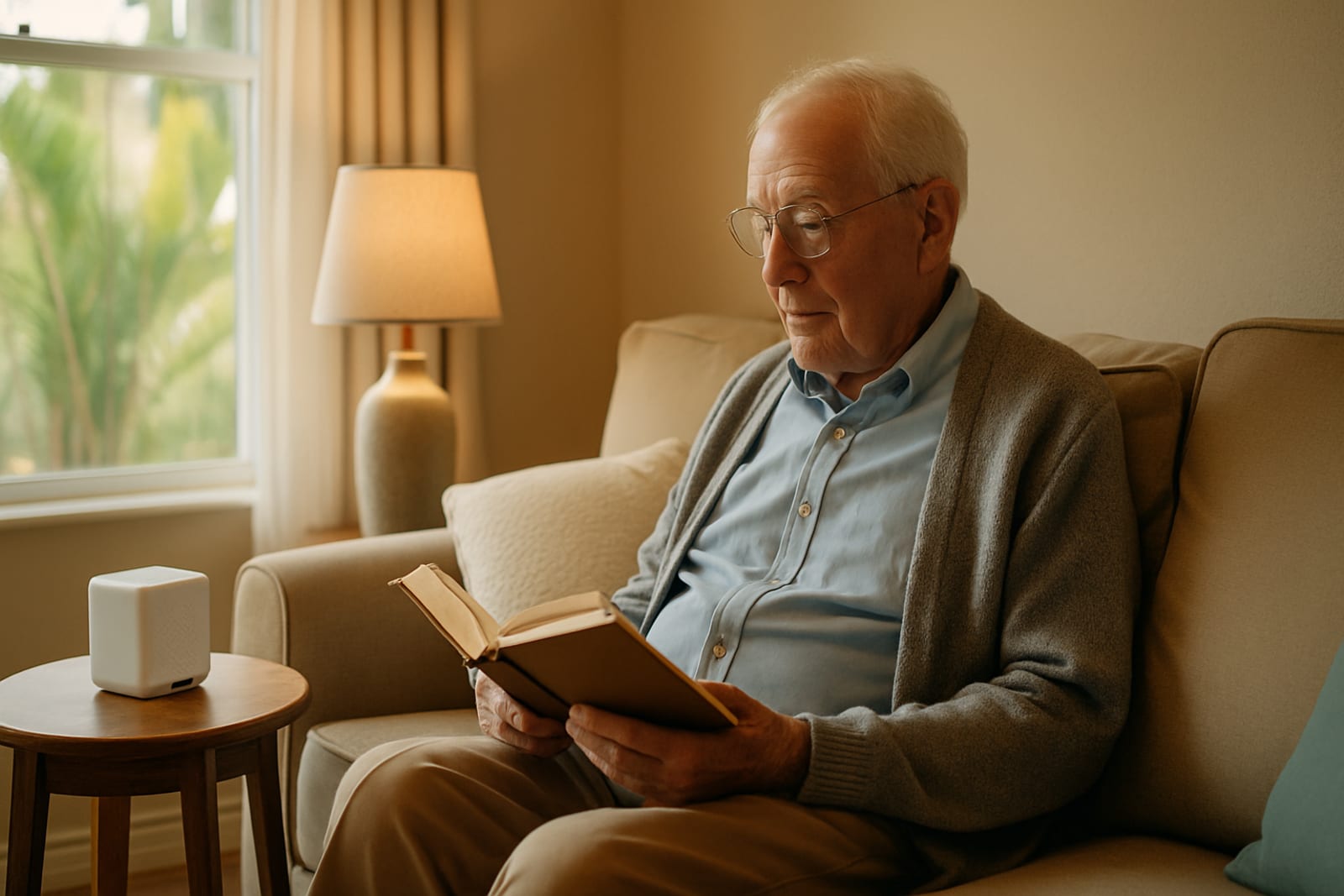
We offer families an in-home monitoring technology called Sensi. Think of it as a set of small, discreet units that plug in around the home. No cameras pointed at your mother. No buttons she has to remember to press. No pendant she will leave in the nightstand drawer because it makes her feel old.
Instead, the system listens for patterns and learns your parent's normal daily rhythm: when they usually get up, how they move through the house, what a typical day sounds like. Then it flags what falls outside that rhythm. A fall. A night where nobody got out of bed. Medications that never got taken. Signs of confusion or distress. Changes that creep in so slowly that nobody visiting once a week would catch them.
Instead of guessing how dad is really doing between visits, you know. That is the whole idea.
Why We Do This for Families Who Have Not Hired Us Yet
Here is the honest answer: because the conversation about care goes better when it starts early, and because we would rather be part of your family's plan than part of your family's emergency.
Some monitoring companies charge families a monthly fee and leave them alone with the alerts. Our approach is different in two ways.
First, if your family does move forward with care through us, the monitoring is included as part of the service. It is not an upsell, and it is not an extra line on the invoice. We treat it the same way we treat our free home safety assessment: as part of doing the job right. We are your eyes and ears in the home. This technology just means our eyes and ears do not clock out when the caregiver goes home, and they are there even before a caregiver ever arrives.
Second, the data does not just sit in an app. It informs the actual care plan. If the alerts show your mom is unsteady at night, that tells us what hours matter most. If everything looks stable except mornings, maybe you do not need 12-hour shifts. Maybe you need a few hours a day, which is a very different conversation, and a much less expensive one. We have said it before: you are not patient 1234. The data helps us make sure the plan fits your parent, not a template.
The Independence Question
We know what some of you are thinking, because parents say it to us all the time: "I don't want to be watched."
That reaction deserves a real answer, not a sales pitch. So here it is.
Monitoring without cameras is not surveillance. It is the same thing you are already doing when you call every day and ask how she is feeling, except it does not depend on her remembering, or on her telling you the whole truth so you will not worry. Most parents downplay. It is an act of love. It is also how small problems stay hidden until they are big ones.
In our experience, the families who frame it honestly get the best response: "Dad, this is what lets you stay in your own house. This is the thing that keeps me from pushing you into something bigger before you need it." For a parent whose real fear is losing independence, data is not the threat. Data is the proof they are doing fine, for as long as they really are.
And when the day comes that they are not doing fine, you will not be guessing. You will know what changed, when it changed, and what kind of help actually fits. That is a far better starting point than a hospital discharge on a Friday night.
What This Looks Like in Practice
A family calls us. Mom is 84, living alone in Boynton Beach, adamant that she does not need anybody. We talk through the situation, and everyone agrees: no caregiver yet. The monitoring goes in. For two months, the data says mom is right, she is doing fine. Everybody breathes easier, including her.
Then the pattern shifts. She is getting up later. There are two near-falls in the bathroom in one week. Instead of a panicked argument, the family has a calm conversation, with facts, and it starts small: a caregiver three mornings a week. Mom accepts it, partly because it is a modest ask, and partly because she was part of the conversation all along instead of the last one to know.
Nothing is too small to start with. That is true of a care schedule, and it is true of a first step like this one.
Where to Start
If you are in that in-between stage right now, watching, worrying, not ready, we would love to talk it through with you. No pressure, and no pitch for hours of care you do not need yet. That is not how we work. By the end of the phone call, at a bare minimum, you will have a clearer picture of your options and what they cost, including the ones insurance may already cover.
Not sure whether it is time for monitoring, a little help, or just a plan for later? That is exactly what the first conversation is for. Call #1 Home Care Services. We will figure it out together.
Need Help With Home Care?
Our care team is ready to answer your questions and help you find the right care solution for your family.